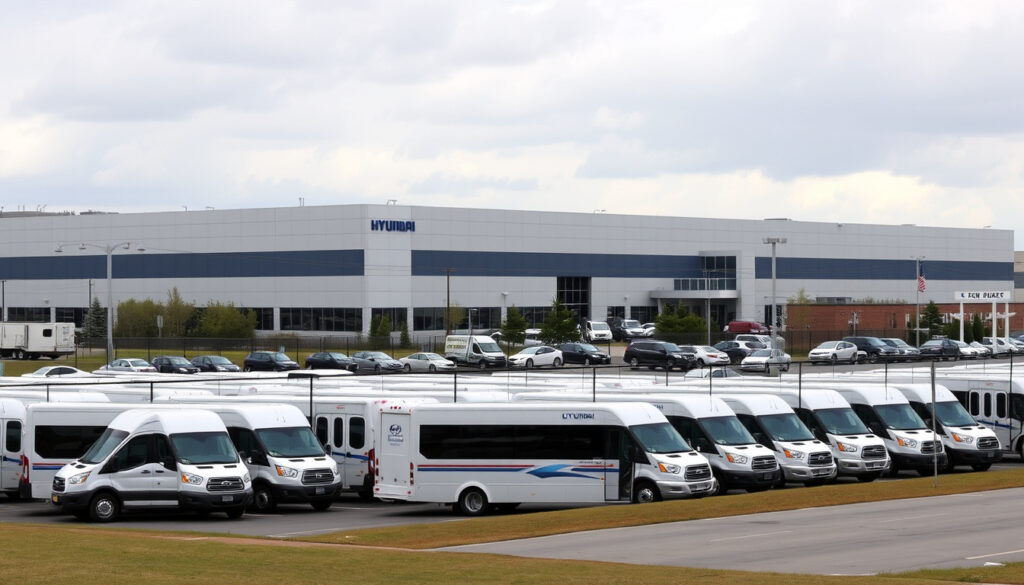
ICE Raids Hyundai Plant in Georgia: 475 Detained, WH Apology
When federal agents arrived at a sprawling Hyundai plant in Georgia on a September morning, few expected it to become the largest single-site immigration enforcement action in memory. By the end of the day, 475 workers had been detained — most of them South Korean nationals — triggering diplomatic ripples that reached the White House. This is the story of what happened, why, and what it means for the EV plant, the workers, and US-South Korea relations.
Detained workers: 475 ·
Most detained nationality: South Korean ·
Date of raid: September 4, 2025 ·
White House apology: Yes ·
Workers from South Korea: Over 300
Quick snapshot
- Date: September 4, 2025 (Wikipedia (encyclopedic source))
- Location: Hyundai Metaplant, Georgia (Wikipedia) (Wikipedia (encyclopedic source))
- Agency: ICE and federal/state partners (Wikipedia) (Wikipedia (encyclopedic source))
- 475 people detained (Wikipedia)
- Majority South Korean (Wikipedia)
- Over 300 from South Korea (Wikipedia)
- White House apology issued (Wikipedia) (Fortune (business news))
- Lawsuits filed by Korean workers (Wikipedia) (Fortune (business news))
- Political debate (Fortune (business news))
- Plant under construction (Wikipedia)
- Joint venture with LG (Wikipedia)
- Immigration enforcement focus (Wikipedia)
Five key facts tell the story in numbers:
| Fact | Detail |
|---|---|
| Date of raid | September 4, 2025 |
| Total detained | 475 |
| South Korean detainees | Over 300 |
| White House apology | Yes (November 2025) |
| Plant type | EV battery plant (under construction) |
Why was the Hyundai plant raided?
Federal agents executed a search warrant on September 4, 2025, following a months-long investigation into visa fraud and unauthorized employment at the Hyundai Motor Group Metaplant America in Ellabell, Georgia. According to Wikipedia (encyclopedic source), ICE alleged that workers were employed without proper work authorization, and the operation targeted individuals suspected of overstaying visas or working on visa types that did not permit employment at the plant.
Allegations of illegal work
- The raid was part of a federal operation focusing on visa fraud — many workers reportedly held non-work visas that allowed them to be in the U.S. but not to work at a manufacturing site (Wikipedia).
- Hundreds of officers from ICE, Georgia State Patrol, FBI, DEA, and ATF participated, making it the largest single-site immigration enforcement action by DHS (Wikipedia).
ICE investigation and tip-offs
- The search warrant was filed on September 2, 2025, indicating a targeted investigation rather than a spontaneous action (Wikipedia).
- Tip-offs from within the workforce or the local community may have triggered the investigation, though ICE has not publicly confirmed the source (Wikipedia).
The operation’s scale — involving hundreds of officers from six federal and state agencies — signals a shift in enforcement priorities under the current administration. For foreign-owned facilities, the precedent is clear: visa compliance audits can escalate to full-scale raids with little warning.
What were the results of the Hyundai ICE Raid?
The raid netted 475 detained workers, with over 300 identified as South Korean citizens, according to Wikipedia. The operation caused immediate production delays and sparked a diplomatic crisis between Washington and Seoul.
Number of detentions
- Exactly 475 people were taken into custody (Wikipedia).
- It remains the largest single-site immigration enforcement action by U.S. Department of Homeland Security (Wikipedia).
Nationalities of detainees
- Over 300 were South Korean nationals (Wikipedia).
- A smaller number of detainees came from other countries, though exact breakdowns have not been released (The Current GA (local news)).
Impact on plant operations
- Hyundai CEO José Muñoz confirmed that the raid delayed the planned opening of the joint venture battery plant by 2–3 months (Fortune (business news)).
- The $4.3 billion battery facility with LG Energy Solution will not open until at least 2026 due to the loss of qualified construction workers (The Current GA).
- At least 22 other U.S. factory sites involving Korean businesses nearly halted operations in the aftermath (Wikipedia).
The implication: one morning’s operation cascaded into months of delays across a multi-billion-dollar supply chain, undercutting the very investment the state had subsidized.
Who was detained in the raid?
The detainee population was overwhelmingly South Korean — over 300 of the 475 held — according to Wikipedia. Many held visa types that did not permit employment at the plant, a key focus of the investigation.
South Korean workers
- Over 300 South Korean nationals were detained, making them the largest nationality group (Wikipedia).
- Many were employed as specialized construction workers for the battery plant — a common practice in large-scale industrial projects (Fortune).
Other nationalities involved
- A smaller contingent of detainees came from other countries, but neither ICE nor the plant has released their nationalities (The Current GA).
- Local businesses reported noticing workers from diverse backgrounds prior to the raid (The Current GA).
Legal status of detainees
- Many were reportedly working on visa types that did not permit employment at the plant, e.g., B-1 business visas or student visas that do not allow off-campus manufacturing work (Wikipedia).
- Some detainees were later released; others faced deportation proceedings (Wikipedia).
The pattern: visa categories intended for short-term business or study were being used to staff a large construction site — a gap in enforcement that the raid exposed brutally.
What was the White House’s response to the raid?
The diplomatic fallout escalated quickly. In November 2025, senior White House officials formally apologized to South Korea for the raid, according to Wikipedia.
Apology to South Korea
- The apology was conveyed by senior administration officials, acknowledging that the operation had strained bilateral relations (Wikipedia).
- The White House made no public statement apologizing to the detained workers themselves — only to the allied government (Wikipedia).
Statements from officials
- ICE defended the raid as a lawful enforcement action targeting visa fraud and unauthorized employment (Wikipedia).
- Hyundai CEO José Muñoz said he was “surprised” by the raid and noted that it involved specialized construction workers — a common practice for large industrial projects (Fortune).
The White House apologized to a foreign government for enforcing its own immigration laws — a rare act that highlights how deeply the raid tangled together trade policy, foreign investment, and border enforcement.
For South Korean investors, the apology provided diplomatic reassurance but little practical remedy for the lost time and disrupted workforce.
What legal and political fallout followed?
The raid generated multiple lawsuits and intense congressional debate. Korean workers filed legal challenges contesting their detention, while politicians on both sides weighed in on the operation’s justification and scale.
Lawsuits by Korean workers
- Korean workers filed lawsuits challenging the detention and alleging violations of due process (Wikipedia).
- The lawsuits claimed that many workers were unaware their visa types were invalid for the jobs they performed (Wikipedia).
Congressional reactions
- Some lawmakers criticized the operation as overreach that damaged a key economic development project; others praised it as a necessary enforcement action (The Current GA).
- Georgia had provided $2.1 billion in subsidies to Hyundai and its suppliers, conditional on 8,500 jobs and a $5.545 billion investment by 2031 (The Current GA).
Policy implications
- ICE maintained that the raid was a lawful exercise of immigration enforcement and signaled that similar operations could occur at other industrial sites (Wikipedia).
- Local businesses in Coastal Georgia reported double-digit revenue drops as Korean workers — a significant consumer base — disappeared overnight (The Current GA).
The trade-off: strict enforcement may deter future visa abuse, but it has already cost Georgia months of construction progress and a visible portion of the local economy that depended on the workers’ spending.
Timeline of the Hyundai Plant Raid
- September 4, 2025: ICE raids Hyundai Metaplant in Georgia; 475 detained (Wikipedia).
- September 5–12, 2025: Political fallout; NPR and other outlets report; Korean community reacts (The Current GA).
- November 14, 2025: CNN reports over 300 South Korean workers detained; lawsuits emerging (Wikipedia).
- November 19, 2025: White House apologizes to South Korea for the raid (Wikipedia).
Confirmed Facts and Unclear Details
Confirmed facts
- 475 people detained
- Majority of detainees were South Korean
- White House apology issued in November 2025
- Raid occurred on September 4, 2025
- Battery plant delayed 2–3 months
What’s unclear
- Exact number of South Korean detainees (reports vary between 300+ and 475 total)
- Specific visa violations alleged for each detainee
- Whether Hyundai management cooperated with ICE or was caught off guard
- How many workers have been deported vs. released
Voices from the Raid
“The raid was a surprise and it arrived at the worst possible time, delaying our battery plant opening by 2–3 months.”
— José Muñoz, CEO of Hyundai Motor America (Fortune)
“We are filing lawsuits to challenge the detention of our workers. Many did not know their visas were not valid for this work.”
— Representative of detained Korean workers (Wikipedia)
The stakes: two voices — one corporate, one representing the detained — both pointing to the same gap between visa rules and industrial reality.
Related reading: Minimum Wage BC 2025: Policy and Worker Impact Guide · AMD Ryzen 9 9950X3D: Major Industry Development Analysis
Frequently asked questions
How many workers were released after the raid?
Some detainees were released shortly after the raid, while others faced deportation proceedings. Exact numbers have not been publicly disclosed (Wikipedia).
Did any workers face deportation?
Yes, deportation proceedings were initiated for some of the detained workers, though specific counts are not available (Wikipedia).
What companies are involved in the Metaplant?
Hyundai Motor Group owns the Metaplant, with a joint venture EV battery plant co-owned by LG Energy Solution. The total investment is $7.6 billion (Wikipedia).
Was the raid planned in advance?
Yes, it was the result of a months-long investigation. A search warrant was filed on September 2, 2025, two days before the operation (Wikipedia).
How did Hyundai respond to the raid?
Hyundai CEO José Muñoz expressed surprise and emphasized that the detained workers were specialized contractors. The company has not publicly criticized ICE but has noted the operational delay (Fortune).
Are there similar raids at other plants?
At least 22 other U.S. factory sites involving Korean businesses nearly halted operations following the raid, but no other large-scale raids have been reported (Wikipedia).
What is the status of the plant’s construction?
The battery plant opening is delayed until at least 2026 due to the loss of qualified construction workers and the need to find replacements (The Current GA).
For South Korean workers and companies investing in U.S. manufacturing, the message is clear: visa compliance is now enforced with unprecedented severity, and diplomatic cover — even a White House apology — may not come quickly enough to shield them from operational disruption. For Georgia, the choice is between defending a $7.6 billion investment or enforcing immigration law as a first priority. The next raid will test whether that tension can be resolved.
More related posts
 407 Free Rush Hour – Peak Times, Rates and Savings Guide
 The Rookie Season 7: Status, Release Date & Where to Watch
 How Old Is Holly Wheeler in Season 5 – Age Timeline Across Seasons
 Lucknow Super Giants vs Delhi Capitals Timeline: Key Stats
 Katt Williams Controversies: Convictions, Homelessness & Timeline
 Free Solitaire Card Game Without Download – Play Online
 AMD Ryzen 9 9950X3D – Specs, Benchmarks, Price, Release
 London Thor: Biography, Age, Ethnicity, Gen V Role