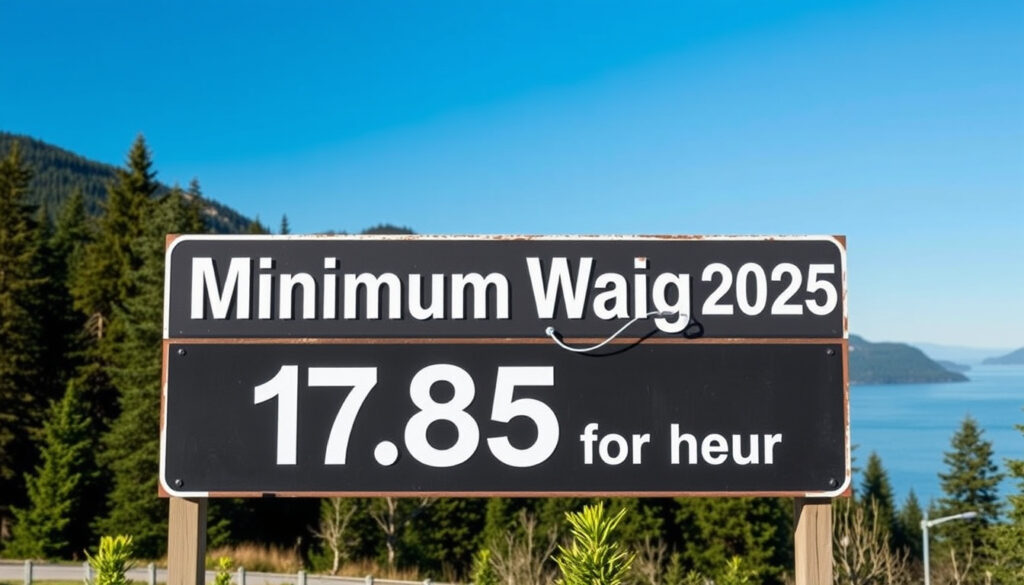
Minimum Wage BC 2025: Official $17.85/hour Rate Update
British Columbia’s minimum wage climbed to $17.85 per hour on June 1, 2025 — up 45 cents from $17.40 — and the province has already locked in the next step to $18.25 on June 1, 2026. With five other provinces also adjusting their floors on October 1, 2025, the map of low-wage Canada is shifting.
BC Minimum Wage June 1, 2025: $17.85 per hour · Previous Rate: $17.40 per hour · Annual Adjustment Basis: Inflation formula · Applies To: Most employees · Next Increase: $18.25 on June 1, 2026
Quick snapshot
- $17.85/hour effective June 1, 2025 (Littler employment law firm)
- Rise tied to December 2024 CPI change (Retail Council of Canada)
- Next jump: $18.25 on June 1, 2026 (Wagepoint payroll resource)
- Exact CPI figure that drove the 2025 adjustment
- Whether cost-of-living adjustments will accelerate beyond inflation-linking
- Federal jurisdiction wage policy direction post-2025
- June 1, 2025: $17.85 (confirmed)
- June 1, 2026: $18.25 (projected)
- BC has raised the floor annually since 2022 via inflation formula
- June 1, 2026 increase to $18.25 already scheduled
- BC remains competitive among provinces but trails Nunavut
- Five provinces adjust October 1, redrawing the comparison landscape
| Label | Value |
|---|---|
| 2025 BC General Minimum Wage | $17.85/hour |
| Effective Date | June 1, 2025 |
| Prior Rate | $17.40/hour |
| Adjustment Method | Annual inflation formula |
| Source | Province of British Columbia |
Is B.C. minimum wage going up in 2025?
Yes — and the change is already in effect. British Columbia’s general minimum wage climbed to $17.85 per hour on June 1, 2025, marking a 45-cent increase from the previous rate of $17.40. The province has now adjusted the floor annually since 2022 using an inflation-tied formula, making these increases predictable for both workers and employers.
Increase amount and date
The $17.85 rate applies to most employees working in British Columbia, regardless of whether they are full time or part time. The increase reflects the annual adjustment based on Consumer Price Index change recorded in December 2024, according to the Retail Council of Canada. Workers paid at or near the minimum can expect their pay stubs to reflect the new rate starting with the June 1 payroll period.
A full-time worker earning $17.85 for 40 hours per week over 52 weeks brings home approximately $37,128 in gross annual earnings before deductions. That figure excludes vacation pay, which British Columbia calculates separately at 4% of total wages.
Who it affects
The $17.85 floor covers the broad majority of hourly workers in the province. Separate lower rates historically existed for liquor servers and certain other categories, but British Columbia has been narrowing those gaps. Any worker whose employer has not updated their rate effective June 1 may have grounds to file a wage complaint with the Employment Standards Branch.
The provincial rate sets a floor, not a ceiling — employers are free to pay above the minimum, and competitive labour markets in sectors like hospitality and retail frequently do. Workers looking to negotiate compensation above minimum wage may benefit from developing skills to put on your resume that demonstrate specialized value.
Increases to Minimum Wage in British Columbia
British Columbia uses a formula tied to the Consumer Price Index to set its annual minimum wage adjustments. This approach, known as indexation, was adopted to keep minimum wage earnings from eroding in real terms as living costs rise.
Annual adjustment formula
Under the current system, the province reviews the CPI figure published by Statistics Canada for December of the preceding year, then applies that rate to determine the new minimum wage for the following June 1. BC’s June 1, 2025 increase reflects the CPI change recorded in December 2024. The formula ensures that when inflation runs hot, minimum wages keep pace — rather than falling behind as they did in some provinces during earlier periods of price stability.
This contrasts with Alberta, which has kept its minimum wage at $15.00 since October 2018 — the lowest general rate in Canada and a figure that has not moved in over six years despite cumulative inflation.
Historical increases
British Columbia began its current streak of annual inflation-linked increases in 2022. Each June 1 adjustment has added between 30 and 60 cents to the hourly floor, depending on the prior year’s CPI movement. The trajectory is clear: the province has signaled that this formula will continue, giving workers and businesses a reliable planning horizon.
Which province has the highest minimum wage?
Nunavut holds Canada’s highest general minimum wage at $19.75 per hour as of September 1, 2025. That figure applies to employees in federally regulated industries working within the territory, as well as to workers directly covered by Nunavut’s territorial employment standards. British Columbia’s $17.85 ranks among the top tier nationally, but it sits below the northern territory’s rate and slightly below Yukon’s $17.94 (effective April 1, 2025).
Top provinces ranked
Among provinces, British Columbia’s $17.85 places it near the top of the list, trailing only Nunavut among all Canadian jurisdictions. When ranked alongside provinces only, BC’s rate compares favorably to most — though the margin narrows when compared to Ontario ($17.60), which is now within 25 cents of BC’s floor.
BC position
BC sits in a cluster with Ontario, Yukon, and the federal rate ($17.75, effective April 1, 2025) — all within roughly 35 cents of one another. The practical gap between being a minimum wage earner in Vancouver versus Toronto has narrowed considerably, though cost-of-living differences mean the same hourly rate stretches differently in each city.
BC’s $17.85 trails Nunavut by nearly $2 per hour. Nunavut’s rate reflects the extreme cost of living in northern and remote communities — a factor the CPI-based formula partly captures but does not fully address.
Current Minimum Wage Rates Across Canada
Thirteen Canadian jurisdictions set their own minimum wages, and the differences are substantial. The range spans from $15.00 in Alberta to $19.75 in Nunavut — a gap of nearly $5 per hour. For workers comparing prospects across provinces, those differences can mean tens of thousands of dollars annually.
Here is how the provinces and territories stack up against BC’s $17.85 as of late 2025:
| Province / Territory | Current Rate | Effective Date | Next Scheduled Increase |
|---|---|---|---|
| Nunavut | $19.75 | September 1, 2025 | Not announced |
| Yukon | $17.94 | April 1, 2025 | $18.51 on April 1, 2026 |
| British Columbia | $17.85 | June 1, 2025 | $18.25 on June 1, 2026 |
| Federal | $17.75 | April 1, 2025 | Tied to CPI annually |
| Ontario | $17.60 | October 1, 2025 | Tied to Ontario CPI |
| Nova Scotia | $16.50 | October 1, 2025 | $17.00 on October 1, 2026 |
| Quebec | $16.10 | May 1, 2025 | $16.60 on May 1, 2026 |
| Manitoba | $16.00 | October 1, 2025 | $16.40 on October 1, 2026 |
| Prince Edward Island | $16.50 | October 1, 2025 | $17.00 on April 1, 2026 |
| Saskatchewan | $15.35 | October 1, 2025 | Index formula |
| Alberta | $15.00 | October 1, 2018 | None announced |
Five provinces implemented increases on October 1, 2025: Ontario, Manitoba, Nova Scotia, Prince Edward Island, and Saskatchewan. Each adjustment was tied either to a CPI index or to a province-specific inflation formula. The simultaneous timing creates a useful snapshot for cross-provincial comparison.
Liquor server and other rates
Some provinces maintain separate lower minimum wages for categories like liquor servers, students, and homeworkers. Ontario’s student minimum wage (workers under 18, 28 hours or less per week) sits at $16.60 as of October 1, 2025. The homeworker rate, for employees working from home under contract, is $19.35. British Columbia eliminated its liquor server differential in 2021, bringing all workers under the same general floor — a policy choice that has narrowed the gap for tipped employees compared to provinces that still use separate categories.
British Columbia’s single-rate approach means no worker in the province falls below $17.85 regardless of their job category. For hospitality workers especially, this is a meaningful protection that provinces with liquor server differentials have not yet matched.
BC Minimum Wage 2025 Calculations
For workers trying to figure out what the $17.85 rate means in practice, the math is straightforward — though the take-home picture changes once taxes enter the picture. Understanding how deductions affect your pay can help with planning, and when Canadian taxes are due may affect your budgeting strategy.
Hourly to annual
At $17.85 per hour for a standard 40-hour work week, the gross annual calculation is:
$17.85 × 40 hours × 52 weeks = $37,128
That figure is gross income before any deductions. After federal and provincial income tax, Canada Pension Plan contributions, and Employment Insurance premiums, a single full-time minimum wage worker in BC might retain approximately $30,000 to $31,000 depending on tax credits and deductions claimed.
40 hours weekly example
The standard full-time benchmark in Canada is 37.5 hours per week, though many employers use 40 hours as their baseline. At 37.5 hours, the calculation shifts slightly:
$17.85 × 37.5 hours × 52 weeks = $34,807.50
For part-time workers at 20 hours per week, annual gross earnings come to roughly $18,564 — a figure that makes saving difficult and unexpected expenses a genuine challenge.
British Columbia’s $17.85 translates to roughly $37,000 gross annually for full-time work — before taxes. That positions BC near the top among provinces, but still below what advocates often cite as a living wage for major urban centres.
Provincial Comparison: How BC Stacks Up
British Columbia’s minimum wage trajectory tells a clear story: the province has committed to inflation-linked annual increases that have elevated its floor significantly above several neighboring jurisdictions. But the comparison depends heavily on which benchmark you use.
The gap between BC ($17.85) and Alberta ($15.00) is $2.85 per hour — the equivalent of nearly $6,000 in annual gross earnings for a full-time worker. Alberta’s rate has not changed since October 2018, a gap that has widened with each BC increase. Saskatchewan, using its own dual-factor index formula, sits at $15.35 — above Alberta but well below BC.
Among provinces that adjust annually via CPI, British Columbia’s approach is among the most transparent. The formula is public, the effective dates are known in advance, and the next increase ($18.25 on June 1, 2026) can be calculated as soon as December 2025 CPI data is released.
Nova Scotia provides an instructive counterpoint. The province applied its standard April 1 CPI-linked increase, then added a second adjustment on October 1 specifically to respond to cost-of-living pressures. This mid-year move reflects a political choice — and one that has closed Nova Scotia’s gap with BC from roughly $2.00 to around $1.35 per hour.
Five Canadian provinces implemented minimum wage increases on October 1, 2025: Ontario, Manitoba, Nova Scotia, Prince Edward Island, and Saskatchewan. Each adjustment reflects either CPI indexation or a province-specific formula.
Saskatchewan’s approach stands apart. The province weights its adjustment formula equally between CPI and the average hourly wage in the province, giving the calculation a labour market component that pure CPI-linked provinces lack. The result is a rate that may move more slowly when inflation spikes but that also factors in broader economic conditions.
The pattern across Canada is clear: most provinces have embraced some form of indexation, with varying formulas and timing. Alberta remains the outlier — and the gap between its floor and BC’s is growing wider with each passing year.
Timeline of BC Minimum Wage Changes
The history of BC’s minimum wage is one of acceleration. After years of irregular, politically-driven increases, the province shifted to a systematic, inflation-linked approach in 2022 that has produced a consistent annual bump each June 1.
Employment law analysts note that the June 1 timing gives businesses several months to plan before peak seasonal hiring in July and August, while workers feel the benefit in mid-year paychecks (Littler, Retail Council of Canada).
| Date | Event |
|---|---|
| June 1, 2025 | General minimum wage rises to $17.85/hour |
| 2024 prior | Rate at $17.40/hour |
| Annual since 2022 | Inflation-tied increases |
The June 1 timing matters. By aligning the adjustment with the start of summer, the province gives businesses several months to plan for the change before peak seasonal hiring periods in July and August. Workers feel the benefit in mid-year paychecks, though the prior year’s CPI data, not current conditions, drives the adjustment.
BC’s next scheduled increase arrives June 1, 2026, when the floor moves to $18.25 per hour. That figure is based on applying the 2025 CPI change to the current $17.85 rate — meaning the December 2025 inflation reading will determine whether $18.25 proves accurate or the number shifts slightly.
What’s Confirmed and What’s Not
The confirmed facts around BC’s minimum wage are solid: the $17.85 rate, the June 1 effective date, and the inflation-linked formula driving future adjustments. Research from legal and employment advisory firms consistently cites these details with high confidence.
Less certain are the broader questions that swirl around minimum wage policy generally. Whether the current indexing pace keeps pace with actual living costs in Vancouver or Victoria remains debated. The formula captures average CPI movement but does not fully account for housing cost spikes that weigh heavily on lower-income workers. What is clear is that $17.85 is a meaningful raise from $17.40, and that the trajectory continues upward.
Confirmed
- $17.85 on June 1, 2025 per gov.bc.ca
- Applies to most employees
- June 1, 2026 increase to $18.25 scheduled
- Formula ties to December CPI
What’s unclear
- Rates post-2026 beyond formula projection
- Whether BC will adopt a living wage standard for public sector contracts
- Exact CPI figure used in the 2025 calculation
What Happens Next for BC Workers
British Columbia’s path is relatively clear: the inflation formula keeps the floor rising annually, and the next step to $18.25 is already on the calendar for June 1, 2026. For workers, that predictability is valuable — you can look ahead and see roughly where the minimum sits in a year.
The broader question is how those increases compare to actual living costs. British Columbia’s rate ranks near the top among provinces, but housing costs in Vancouver and Victoria remain high relative to wages. The $17.85 figure covers the floor; it does not guarantee a living wage in all circumstances.
For workers in BC, the immediate takeaway is straightforward: your minimum wage is higher than it was a year ago, it will be higher again next June, and the increase is rooted in a formula you can track yourself using Statistics Canada’s CPI data.
thrivelawyers.ca, safeguardglobal.com, nethris.com, youtube.com, govdocs.com
British Columbia’s minimum wage rose to $17.85 per hour on June 1, 2025, with details matching Canadascopes BC overview.
Frequently asked questions
Why is B.C.’s minimum wage so high?
BC’s minimum wage ranks near the top among Canadian provinces because the province adopted an annual inflation-indexed formula in 2022. The formula links increases to the Consumer Price Index, ensuring the floor rises each year rather than stagnating. Alberta, by contrast, has held its rate at $15.00 since 2018 — the lowest in Canada.
Is $17.85 an hour good in Canada?
$17.85 per hour positions BC near the top provincial minimum in Canada, trailing only Nunavut ($19.75) and Yukon ($17.94). At 40 hours per week, it yields roughly $37,000 gross annually. That is above many provinces but falls short of what advocates often cite as a living wage for major urban centres, particularly in Vancouver where housing costs are significant.
What is the lowest paying job in Canada?
Minimum wage in Alberta — $15.00 since October 2018 — represents the lowest general provincial minimum in Canada. Workers in Alberta earn the smallest floor legally, a gap that has widened as other provinces have raised their floors through inflation-linked adjustments.
How much is 40 hours on minimum wage in BC?
At $17.85 per hour for 40 hours per week over 52 weeks, gross earnings are approximately $37,128 before taxes. After federal and provincial income tax, CPP, and EI deductions, take-home pay for a single worker is roughly $30,000–$31,000 depending on tax credits.
What is the minimum salary for a 37.5 hour week in BC?
At $17.85 per hour for 37.5 hours per week over 52 weeks, gross annual earnings come to approximately $34,807.50 before deductions. This is the standard full-time benchmark used by many Canadian employers.
Who has the highest minimum wage in 2025?
Nunavut holds the highest minimum wage in Canada at $19.75 per hour as of September 1, 2025. Among provinces (excluding territories), British Columbia’s $17.85 and Yukon’s $17.94 are among the highest, with Ontario at $17.60 and the federal rate at $17.75.
What is BC minimum wage for 2024?
British Columbia’s minimum wage was $17.40 per hour from June 1, 2024 through May 31, 2025. That figure was itself an increase from the prior rate, continuing the inflation-linked annual adjustment pattern that began in 2022.
More related posts
 Dancing with the Stars 2025 Ireland: Season 8 Winners & Recap
 When Are Canadian Taxes Due in 2026? Key Deadlines
 ערוץ 12 שידור חי – Official Free Live Streaming Guide
 ICE Raids Hyundai Plant in Georgia: 475 Workers Detained
 MF Doom Cause of Death: Angioedema Reaction in Leeds Hospital
 World War Z 2 – Status, Cast and Release Updates
 2025 IIHF World Championship: Results Schedule Winner
 Whole House Reverse Osmosis System: Worth It, Cost & Reviews