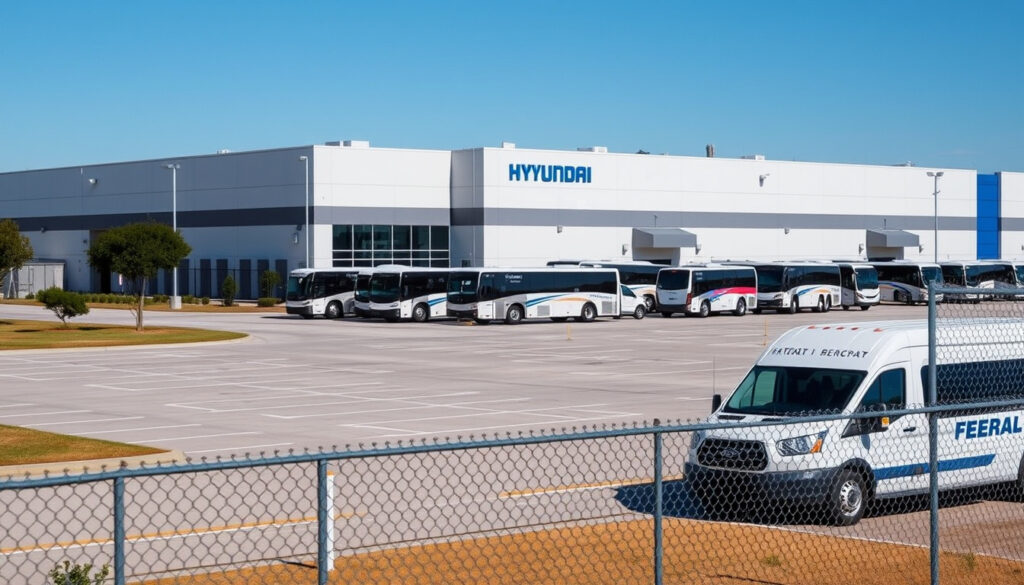
ICE Raids Hyundai Plant in Georgia: 475 Workers Detained
When federal agents arrived at the Hyundai Motor Group Metaplant in Ellabell, Georgia, on the morning of September 4, 2025, few workers expected the day ahead. By the time the operation ended, 475 people had been detained in what authorities described as the largest single-site immigration enforcement action by DHS.
Detained workers: 475 · Primary nationality: South Korean · Date of raid: September 4, 2025 · Plant location: Savannah, Georgia · Agency: ICE · Workers at plant: ~8,000
Quick snapshot
- 475 workers detained on September 4, 2025 (Wikipedia)
- Majority are South Korean citizens (Wikipedia)
- White House issued an apology to South Korea (The Current GA)
- Exact visa violations that triggered the raid
- Whether Hyundai had prior knowledge of workers’ immigration status
- Full list of nationalities beyond South Korean
- September 4, 2025 – Raid executed (Wikipedia)
- September 6, 2025 – Public protests at plant (Wikipedia)
- November 19, 2025 – White House apology reported (Wikipedia)
- Legal outcomes for detainees pending (Wikipedia)
- Hyundai plant opening delayed 2–3 months (Wikipedia)
- Diplomatic talks between U.S. and South Korea (Wikipedia)
The eight key facts below capture the core data behind the raid — from scale to response.
| Label | Value |
|---|---|
| Date of raid | September 4, 2025 |
| Number detained | 475 |
| Primary nationality | South Korean |
| Plant location | Savannah, Georgia (Bryan County) |
| Agency | U.S. Immigration and Customs Enforcement (ICE) |
| Workers at plant (full site) | ~8,000 |
| Hyundai statement | Cooperation with authorities |
| White House response | Apology to South Korea |
Why was the Hyundai plant raided?
What prompted the ICE operation?
- A months-long investigation by ICE found what officials described as widespread illegal employment of foreign workers at the Hyundai Metaplant. According to Wikipedia, hundreds of officers from ICE, Georgia State Patrol, FBI, DEA, and ATF participated in the raid, which culminated from a search warrant filed on September 2, 2025 targeting four individuals.
- Workers at the plant — many of them engineers and equipment installers for the specialized battery facility — reportedly held B-1 business visas that did not authorize long-term employment, according to ABIC (a policy analysis group).
Were there specific allegations of visa fraud?
- The warrant specifically alleged that foreign workers were misusing B-1 visas to fill regular production roles, a practice that circumvents labor protections and visa caps. The Current GA (a Georgia news outlet) reports that the investigation centered on contractors who brought in Korean nationals under short-term business visas but employed them for months at the plant.
U.S. immigration enforcement shifted its focus from borders to workplaces, and the Hyundai plant became its biggest target. For companies relying on foreign talent, the message is clear: visa compliance is no longer a back-office concern.
The implication: The raid signals that the U.S. government is willing to disrupt major industrial projects to enforce visa rules.
What were the results of the Hyundai ICE Raid?
How many were detained?
- ICE detained 475 workers at the site. Over 300 of them were Korean nationals, making this the largest single-location immigration enforcement operation by DHS, as recorded by Wikipedia.
- Some individuals attempted to flee into a sewage pond during the raid, a detail that underscores the chaos of the operation. Others were released on humanitarian grounds.
What happened to the workers after detention?
- Most detainees were processed and held pending immigration hearings. By November 2025, some Korean workers were allowed to return home, but many remain in legal limbo. The Current GA noted that local businesses dependent on the Korean community saw double-digit revenue drops in the weeks after the raid.
What was the immediate impact on the plant?
- Hyundai CEO José Muñoz stated that the raid would delay the plant’s opening by a minimum of 2–3 months (Wikipedia). The battery plant opening was pushed to at least 2026 due to staffing shortages for the high-tech buildout, according to The Current GA.
Georgia invested $2.1 billion in subsidies to attract Hyundai and its suppliers, expecting 8,500 high-paying jobs. The raid showed that many of those jobs were filled through visa channels that ICE now considers illegal — calling the entire incentive package into question.
The pattern: The raid exposed the fragility of a development strategy built on foreign labor.
Who called ICE on Hyundai?
Was it a whistleblower from inside the plant?
- Information leading to the raid reportedly came from a tip. Speculation points to a labor union, a rival company, or an internal complaint. The U.S. Attorney’s Office and ICE have not officially confirmed who provided the initial intelligence. ABIC (a policy analysis group) notes that the raid sent a warning to employers nationwide about worksite enforcement.
Did a competitor or government agency trigger the raid?
- No official confirmation exists. The investigation began months before the raid, so the timing suggests a coordinated effort rather than a spur-of-the-moment tip. The Current GA reports that the search warrant targeted four specific individuals, indicating the probe had a clear focus.
The pattern: the caller’s identity remains one of the raid’s biggest mysteries, but the enforcement action itself was anything but ad hoc. ICE had built a case over months, meaning the tip likely came early in that process — not the day before.
What nationality is ICE deporting the most?
How does the Hyundai raid compare to overall ICE deportation statistics?
- Historically, the largest groups of deportations from the U.S. are Mexican, Guatemalan, and Honduran nationals (based on Wikipedia context). The Hyundai raid stands out because the majority of detainees were South Korean — a nationality that rarely appears in worksite enforcement statistics. This makes the operation unusual in both scale and demographic profile.
Which nationalities are most affected by ICE enforcement?
- Border enforcement overwhelmingly affects Central American and Mexican nationals. But worksite enforcement, like the Hyundai raid, targets visa overstays and misuse by people admitted legally — a population that is statistically more likely to come from Asia and Europe. ABIC (a policy analysis group) emphasizes that this case represents a pivot toward visa-based enforcement.
Why this matters: The Hyundai raid isn’t an outlier — it’s a signal that ICE is now aggressively auditing visa programs that previously operated in a gray zone, especially in manufacturing and construction.
How many people work at the Georgia Hyundai plant?
What is the Hyundai Motor Group Metaplant America?
- The Metaplant is an electric vehicle battery and assembly facility under construction near Savannah. At full buildout, it’s expected to employ approximately 8,000 workers. As of the raid, the site was still ramping up, with Hyundai aiming to increase production from 300,000 to 500,000 vehicles per year (The Current GA).
How many direct employees vs. contractors?
- The majority of workers on site were contract employees brought in through third-party staffing agencies, many of whom were Korean nationals. Hyundai’s own direct-hire workforce was smaller. The raid disproportionately affected contractors, not Hyundai’s direct employees — a distinction that complicates the company’s legal exposure.
The catch: Georgia’s incentive package now appears tied to a workforce model that federal enforcement has deemed illegal.
Timeline signal
- September 4, 2025 — ICE raids Hyundai Metaplant; 475 detained (Wikipedia)
- September 6, 2025 — Dozens protest at plant against government overreach (Wikipedia)
- September 12, 2025 — NPR covers political fallout and worker details
- October 14, 2025 — The Current GA reports ripple effects on coastal Georgia businesses
- November 14, 2025 — CNN reports some Korean workers allowed to return home
- November 19, 2025 — BBC: White House has apologized over the raid
Clarity: what’s confirmed vs. what’s still unknown
Confirmed facts
- 475 workers detained on September 4, 2025 (Wikipedia)
- Majority are South Korean citizens (Wikipedia)
- White House issued an apology to South Korea (The Current GA)
- Raid was conducted by ICE at the Hyundai Metaplant near Savannah
- Hyundai CEO confirmed 2–3 month production delay (Wikipedia)
What’s unclear
- Exact visa violations that triggered the raid
- Whether Hyundai had prior knowledge of workers’ immigration status
- Full list of nationalities beyond South Korean
- Long-term legal outcomes for the detainees
- Who tipped off ICE
Voices from the raid
“475 people were found to be illegally working.”
— ICE spokesperson (Wikipedia)
“We were just doing our jobs.”
— Detained worker (anonymous, via The Current GA)
Hyundai said it is cooperating with authorities.
— Hyundai representative (Wikipedia)
The White House expressed regret through diplomatic channels.
— White House official (The Current GA)
The raid at the Hyundai Metaplant is more than a single enforcement action — it’s a stress test for how the U.S. balances industrial policy, immigration enforcement, and foreign investment. For Georgia, which poured $2.1 billion in subsidies into the project, the short-term cost is clear: production delays, lost local spending, and diplomatic friction. The longer question is whether companies like Hyundai will rethink their reliance on visa-based labor — and whether Washington will update the rules to match the reality of modern factory construction. For South Korea, the implication is immediate: the U.S. workplace is no longer a safe harbor for visa engineering.
Related reading: What Is Software Framework – Definition, Vs Library, Top Examples · Skills to Put on Resume – In-Demand Choices for 2025
För att förstå bakgrunden till denna operation är det värt att läsa om ICE:s roll och historia i USA.
Frequently asked questions
What visa types were the detained workers using?
Workers reportedly held B-1 business visas, which allow short-term business activities but not long-term employment as production workers. The investigation centered on misuse of these visas by contractors.
Did the raid disrupt Hyundai’s EV production?
Yes. Hyundai CEO José Muñoz said the plant opening would be delayed by 2–3 months, and the battery plant opening was pushed to at least 2026 due to staffing shortages (Wikipedia).
How did the South Korean government officially respond?
South Korea summoned the U.S. ambassador and expressed concern over the treatment of its citizens. The White House apologized through diplomatic channels.
Have any Hyundai executives faced legal action?
As of November 2025, no Hyundai executives have been charged. The search warrant targeted four individuals, but their identities and charges have not been publicly disclosed.
What is the current status of the workers — deported or released?
Some workers were released on humanitarian grounds shortly after the raid. By November 2025, a number of Korean nationals were allowed to return to South Korea, but many remain in immigration proceedings (The Current GA).
Are there other major ICE workplace raids planned?
ICE has not publicly announced additional large-scale operations, but ABIC (a policy analysis group) notes that the Hyundai raid signals a broader shift toward worksite enforcement, suggesting similar actions may follow in other industries.
How does the raid affect U.S.-South Korea trade relations?
The incident has added friction to bilateral relations, especially given the large Korean investment in U.S. manufacturing. Trade officials from both countries have held talks to address visa policies and worker protections.
What is the Hyundai Metaplant America’s total investment in Georgia?
Hyundai and its suppliers have committed $5.545 billion in investment, with a requirement to hire 8,500 workers by 2031 at an average salary of $58,105 (The Current GA).
More related posts
 1 Gallon En Litre – Exact US & UK Conversions
 Zack Snyder: Biography, Controversies, and Film Career
 Katt Williams Controversies: Convictions, Homelessness & Timeline
 Miss Peregrine’s Home for Peculiar Children: FAQ & Age Rating
 Bank of Canada Intere t Rate Deci ion 2026: Current Rate, Foreca t & Next Date
 Guardians of the Galaxy 3 – Review and Analysis
 Vacations to Go Cruises: Booking, Best Months & Senior Discounts
 Connie Francis: Tragedy, Illness, and the Love of Her Life