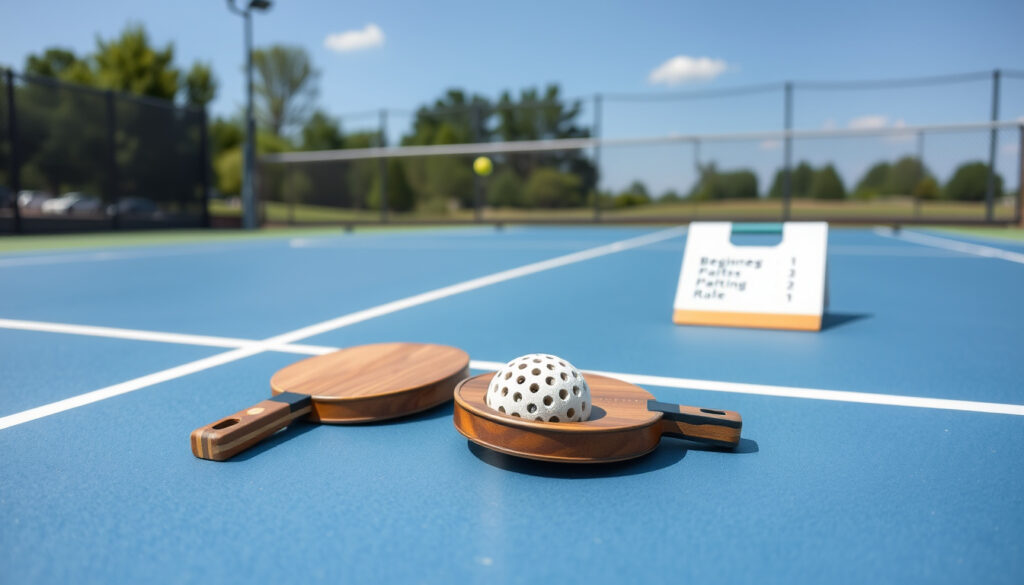
How to Play Pickleball: Rules and Scoring for Beginners
Pickleball merges tennis strategy with badminton pace on a court one-third the size of a tennis singles court. The rules take one afternoon to learn, yet the double bounce and kitchen tactics keep players refining their game for years.
Court size: 20×44 feet · Net height: 36 inches at center · Serve type: Underhand below waist · Players per game: 2 or 4 · Games to 11: Win by 2 points
Quick snapshot
- Games end at 11 points, win by 2 (Ellington Racquet Club)
- Non-volley zone spans 7 feet from net on each side (Helios Pickleball)
- Each doubles team gets 2 serves per turn (Ellington Racquet Club)
- Exact health impact varies by individual baseline fitness
- Regional rule adaptations not fully documented in official summary
- USA Pickleball official rules summary remains current reference
- Tournament options extend to 15 or 21 points for competitive play
The table below distills the core specifications that govern competitive and recreational play across most facilities.
| Field | Value |
|---|---|
| Official rules source | USA Pickleball |
| Typical game length | 15–30 minutes |
| Calorie burn per hour | 400–600 |
| Lightweight paddle weight | 7–8.5 ounces |
| Senior age brackets start | 50 years |
How do you play basic pickleball?
Pickleball sits in an unusual sweet spot among racquet sports: the court is roughly one-third the size of a tennis court, the paddles are solid rather than strung, and every rally begins with a serve followed by a rule called the double bounce. That single rule is what makes the game click.
Court and equipment basics
The court measures 20 by 44 feet — a rectangle that fits inside a tennis singles court with room to spare. A net stretches across the middle at 36 inches high at the center, dropping to 34 inches at the sidelines. The surface can be indoor hard court, outdoor asphalt, or even concrete; what matters is that the lines are clearly marked and the footing is stable.
Equipment-wise, a beginner needs just three things: a paddle, a perforated plastic ball, and court shoes with non-marking soles. According to StoryPoint Group (senior living wellness resource), seniors should prioritize a lightweight paddle — ideally 7 to 8.5 ounces with a polymer core — to reduce joint fatigue during play. The ball itself is hollow with small holes, similar to a wiffle ball but slightly harder.
Starting the game
Every pickleball rally begins with a serve. The server stands behind the baseline, hits the ball underhand so that it arcs below the waist, and directs it diagonally cross-court to the opponent’s service box. Ellington Racquet Club notes that the paddle face must be open — the head cannot rise above the wrist at contact.
Once the ball is served, the double bounce rule kicks in: the ball must land once in play, bounce once on the receiving side, and then bounce once on the serving side before either team can hit it in the air (volley). YouTube beginner guide explains that this two-bounce pause is what separates pickleball from tennis and keeps rallies long enough for beginners to engage.
The implication is that serve placement matters less than in tennis — you are buying time, not pressing for a winner. That fact alone makes the serve far less intimidating for a first-time player than it looks.
What are the 10 basic rules of pickleball?
Pickleball’s official rules are maintained by USA Pickleball, which publishes a summary document covering tournament and recreational play. The most frequently enforced rules at community courts cluster into three areas: serve mechanics, the non-volley zone, and fault definitions.
Serving rules
- The serve is always underhand, contact made below waist level.
- The paddle head must not be above the wrist at the moment of contact (US Senior Pickleball).
- The ball is struck diagonally cross-court from behind the baseline.
- In doubles, the first server always begins from the right (even) side of the court.
- The server must verbally announce the score before each serve — three numbers: your score, opponent’s score, server number.
According to Paddletek (pickleball equipment specialist), the verbal score call is mandatory in doubles because it keeps both teams synchronized as serves rotate.
Non-volley zone
The non-volley zone — universally called “the kitchen” — extends 7 feet from the net on each side. Players may not volley (hit the ball in the air without letting it bounce) while standing inside the kitchen or with any part of their body or paddle touching the kitchen line. Helios Pickleball emphasizes that this rule protects the net area for strategic play and prevents aggressive smashes that would end rallies instantly.
Faults and rallies
- Faults include: volleying inside the kitchen, letting the ball bounce twice, hitting out of bounds, hitting into the net, or failing to clear the non-volley zone line.
- A point is scored only when the opposing team commits a fault.
- Ball touching any line is considered good — lines are “in.”
The catch: because only the serving team scores, games develop a distinct rhythm where one side holds serve and the other defends. This makes service games feel high-stakes in a way that recreational tennis rarely does.
Is pickleball easy for beginners?
Most people who try pickleball for the first time can rally the ball back and forth within 30 minutes. That alone sets it apart from tennis or badminton, where baseline competence typically requires several sessions. Helios Pickleball reports that adults over 55 represent one of the largest groups of regular players in the sport, a demographic fact that reflects how accessible the game is for bodies that no longer tolerate high-impact movement.
Learning curve
The learning curve is gentle because the court is small — errors travel less far, recoverability is higher, and even a weak return often stays in play long enough to reset. Selkirk Sport (pickleball equipment manufacturer) notes that games are typically played to 11, 15, or 21 points — meaning sessions are short and satisfying even when skill gaps exist between opponents.
For seniors, the key adaptation is starting with doubles rather than singles. Doubles cuts the court coverage roughly in half, which matters when lateral movement is slower. The other critical adaptation is equipment: a paddle in the 7–8.5 ounce range with a polymer core absorbs shock through the wrist and elbow — a real benefit for players managing arthritis or prior joint injuries.
Common beginner mistakes
- Volleying too soon: Reaching for balls in the kitchen before they bounce is the most frequent fault among new players.
- Serving too hard: The underhand serve should arc gently. Power is a liability, not an asset, at the baseline.
- Standing in the kitchen: New players often drift into the non-volley zone between rallies and get called for a fault on the next volley.
- Forgetting the double bounce: Hitting the ball out of the air on the first return after a serve is a fault — the ball must bounce on each side before volleys begin.
How to get started playing Pickleball?
Joining the game takes less planning than most people expect. Community courts are increasingly common, and the equipment investment for a first season is modest.
Finding places to play
Many municipal recreation centers now dedicate specific courts to pickleball, often sharing space with tennis or basketball during off-peak hours. StoryPoint Group advises checking local parks department schedules and community center bulletin boards, which often list open play times. Senior centers frequently organize sessions specifically for players 50 and older — a useful entry point because the pace tends to be measured and the instruction is calibrated for players who are returning to sport after a long gap.
For players with heart conditions — including atrial fibrillation — consulting a physician before starting is a responsible step. Helios Pickleball explicitly recommends a medical check for anyone over 60 who is resuming regular physical activity, regardless of how gentle the sport appears.
Equipment needed
- Paddle: Composite or polymer core paddles in the 7–8.5 oz range are well-suited for beginners over 50.
- Balls: Indoor and outdoor balls differ by material hardness; most community courts specify which type they use.
- Shoes: Court shoes with good lateral support and non-marking soles are standard. Running shoes can slip on hard indoor surfaces.
- Comfortable clothing: Moisture-wicking fabric helps during extended rallies, particularly in warm weather.
The total starter kit — paddle, balls, and shoes — typically runs between $60 and $120 depending on paddle quality. Pickleheads (community platform) emphasizes that beginners do not need premium paddles; a mid-range composite paddle performs well for the first several months of play.
How to play pickleball scoring?
Pickleball scoring follows one rule that surprises newcomers: only the team serving can score a point. When the serving team makes an error — hitting out, into the net, or failing to return — the ball passes to the receiving team, but no point is awarded. This rule, called side-out scoring, is what gives pickleball its distinctive pressure dynamic.
Doubles scoring
In doubles, the server calls three numbers before each serve: the serving team’s score first, the receiving team’s score second, and a server number third (1 or 2, indicating which server on the team is hitting). Paddletek explains that this three-number system keeps both teams aware of serve rotation throughout the game.
Each team gets two serves per turn in doubles, except during the very first serve of the game. After the serving team loses a rally, the serve passes to the partner on the same side, then to the opposing team when both serves are lost. Ellington Racquet Club confirms that the first server always starts from the right (even) side of the court.
Winning the game
Recreational games are played to 11 points, and the serving team must win by a margin of 2 points. Tournament play commonly extends to 15 or 21 points, also requiring a 2-point margin. Selkirk Sport notes that competitive matches are typically best of three games.
The paradox: because only the serving team accumulates points, a game can end with one side having scored zero. That scenario — serving flawlessly while the opponent never earns a point — is less common than it sounds, but it illustrates how the serving team’s mental focus shapes the scoreline.
Scoring confusion is the number one cause of friction at community courts. Before the first serve of a new game, agree verbally on the starting score and confirm the serving side. A five-second pause to get the score right saves minutes of argument later.
How to play pickleball step by step
These steps take a complete beginner from zero court time to their first organized rally. Each step builds on the one before.
- Book a court or find open play. Municipal recreation centers, community centers, and church gyms often host beginner sessions. Check local listings for times specifically labeled “beginner” or “open play.”
- Borrow or buy a paddle. A mid-range paddle in the 7–8.5 ounce range works for players of any age. If borrowing from a friend, confirm the grip size feels comfortable — too small causes wrist strain, too large reduces control.
- Warm up for five minutes. Light jogging in place, arm circles, and gentle lunges raise heart rate gradually. StoryPoint Group specifically recommends a warm-up for senior players to reduce strain risk.
- Practice the underhand serve. Stand behind the baseline, hold the ball at waist level, swing upward without letting the paddle head rise above the wrist, and aim diagonally to the opposite service box. Aim for a gentle arc — the ball should land just inside the baseline.
- Learn the double bounce. After a serve, both teams must let the ball bounce once on their side before volleying. Practice this by having a partner serve while you intentionally let the ball bounce before returning it.
- Stay out of the kitchen. During practice rallies, one player stands at the non-volley zone line and calls out “kitchen!” whenever the other player drifts too close during a volley. This trains the spatial awareness needed in live play.
- Play to 11. Keep score using the three-number system (serving score, receiving score, server number). Remember: only the serving team scores, and wins require a 2-point margin.
Bend your knees and drop your center of gravity when hitting ground strokes. Pickleheads notes that low-to-the-ball contact gives seniors better stability and reduces the torque placed on knees and hips during lateral movement.
Upsides
- Rules are simple enough to learn in one session
- Small court means less ground to cover — good for players with mobility limits
- Low-impact movement protects joints while building bone density
- Doubles format reduces individual court coverage by roughly half
- Burns an estimated 400–600 calories per hour — comparable to brisk walking for most players
- Strong community culture with regular social play at most skill levels
Downsides
- Surface injuries (wrist, elbow, shoulder) can result from poor paddle grip or overuse
- Outdoor play is weather-dependent; indoor court access can be limited in some areas
- Noise from paddles and balls is a recurring complaint in residential areas
- Court availability has not kept pace with surge in popularity in many regions
- Competitive play after age 65 requires lifestyle adaptations as reaction time slows
“This rule prevents the serve-and-smash game seen in tennis and helps keep rallies going longer — great for beginners.”
— Ellington Racquet Club
“You don’t need to move faster — you need to move smarter.”
— Pickleball Coach (YouTube)
Related reading: exercise tips for beginners
Global players follow much the same standards worldwide, as this Swedish pickleball rules guide demonstrates in clear Swedish for easy reference.
Frequently asked questions
How many players are needed for pickleball?
Pickleball can be played as singles (2 players, one per side) or doubles (4 players, two per side). Most community play uses the doubles format, which reduces the court area each player must cover and makes the game more social.
What is the non-volley zone in pickleball?
The non-volley zone, informally called “the kitchen,” is the area extending 7 feet from the net on each side of the court. Players may not volley (hit the ball in the air) while standing inside this zone or touching its boundary line.
Can beginners play pickleball doubles?
Yes, and it is the recommended format for beginners. Doubles reduces the amount of court each player needs to cover, making positioning easier and rallies longer. Most community play is organized as doubles specifically because it accommodates mixed skill levels.
What equipment do I need to start pickleball?
A pickleball paddle, a set of balls (indoor or outdoor), and court shoes with non-marking soles are the essentials. For players over 50, a lightweight paddle in the 7–8.5 ounce range with a polymer core is the most important investment for joint comfort and longevity.
Is pickleball played indoors or outdoors?
Both. Indoor pickleball uses a harder ball designed to travel farther on hard surfaces, while outdoor play uses a slightly softer ball that performs better in wind and on outdoor concrete or asphalt courts. Most municipal facilities offer both.
How do you score in pickleball doubles?
In doubles, the server calls three numbers before each serve: the serving team’s score, the receiving team’s score, and the server number (1 or 2). Points are scored only by the serving team, and the game is won at 11 points with a 2-point margin in recreational play.
What causes a fault in pickleball?
Common faults include: volleying inside the non-volley zone, letting the ball bounce twice, hitting the ball out of bounds, failing to clear the net, or hitting the ball into the net. The opposing team earns a point — or side-out — when a fault occurs.
For players in their 50s and beyond, the choice is clear: start with doubles, pick up a lightweight paddle, and prioritize placement over power. The court rewards patience, and the community rewards consistency. A player who shows up twice a week for a month will be more dangerous than one who practices daily for two weeks and quits from frustration. Pickleball rewards the steady over the spectacular — which, for older players, turns out to be exactly the right incentive structure.
More related posts
 Train from Toronto to Montreal: Schedule, Prices & Times
 Air Canada Baggage Fees – Carry-On Rules and Checked Costs 2025
 Taylor Dearden: Neurodivergent, Family & Career Facts
 Minimum Wage BC 2025: Official $17.85/hour Rate Update
 Ekana Cricket Stadium B Ground – LSG’s Key Practice Venue
 Brittany Murphy Death Investigation: Facts vs Myths
 Neil Young Tour Cancelled – Reasons Behind the Decision
 Weather Sault Ste Marie – Current Forecast & 10-Day Outlook